

How assistance systems can respond to emotions
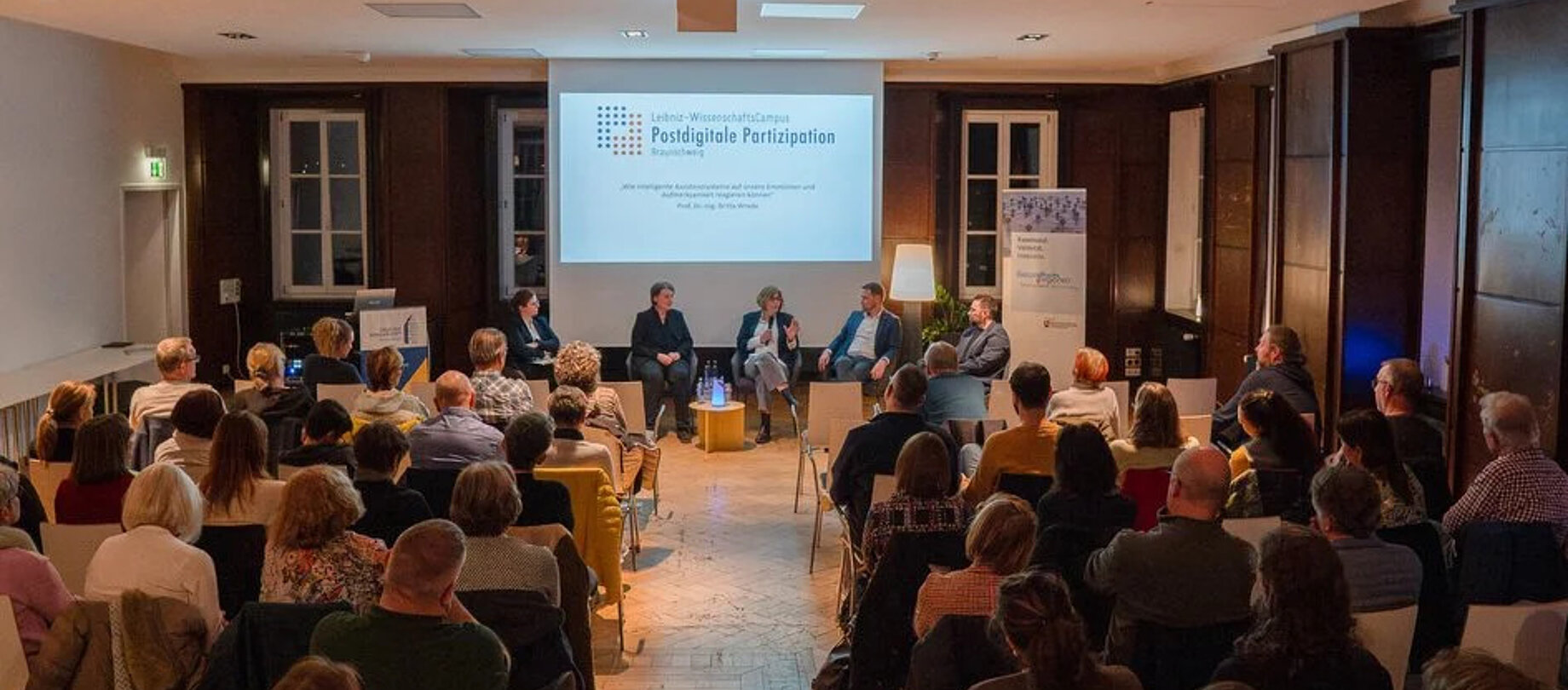
Last Thursday evening, the fifth floor of the Haus der Wissenschaft in Braunschweig was transformed into a forum for the future of social and medical care. Under the title ‘How intelligent assistance systems can respond to our emotions and attention’, Prof. Dr Sandra Verena Müller, on behalf of the Leibniz Science Campus for Post-Digital Participation in Braunschweig, hosted a lecture followed by a panel discussion, which attracted enormous interest. The hall was filled to capacity, and the organisers continued to receive requests for additional seats well into the late afternoon.
The event was opened by Dr Jeremias Othman, Managing Director of the House of Science, who welcomed the guests in the early evening atmosphere. In her welcoming address, City Councillor Dr Christina Rentzsch, Head of the Department of Social Affairs, Schools, Health and Youth, emphasised the importance of regional networking. As Chair of the Braunschweig Health Region, she emphasised the guiding principle of “local, networked and innovative” to bring technological innovations directly to the people in the region. The Dean of the Faculty of Social Work, Prof. Dr Sandra Verena Müller, also warmly welcomed the audience, thanked everyone involved for making this interdisciplinary exchange possible, and introduced the topic.
The subsequent specialist presentation by Prof. Dr.-Ing. Britta Wrede from Bielefeld University provided in-depth insights into the work of the Research Division for Inclusive Medicine. A key problem in today’s healthcare system is the diagnosis of people with intellectual disabilities, as traditional methods often rely on standardised questionnaires. However, these require an ability for self-assessment and reflection that is not always sufficiently present in this group of people, which can lead to misdiagnoses or overmedication. Prof. Wrede presented the GazeAid project, which takes an objective technical approach. Instead of relying on verbal statements, the system uses eye-tracking analysis and EEG data to precisely measure attention patterns and thus, for example, support an ADHD diagnosis.
